


Zorro
Arizona Opera's swashbuckling 'Zorro' lacked a musical sense of place
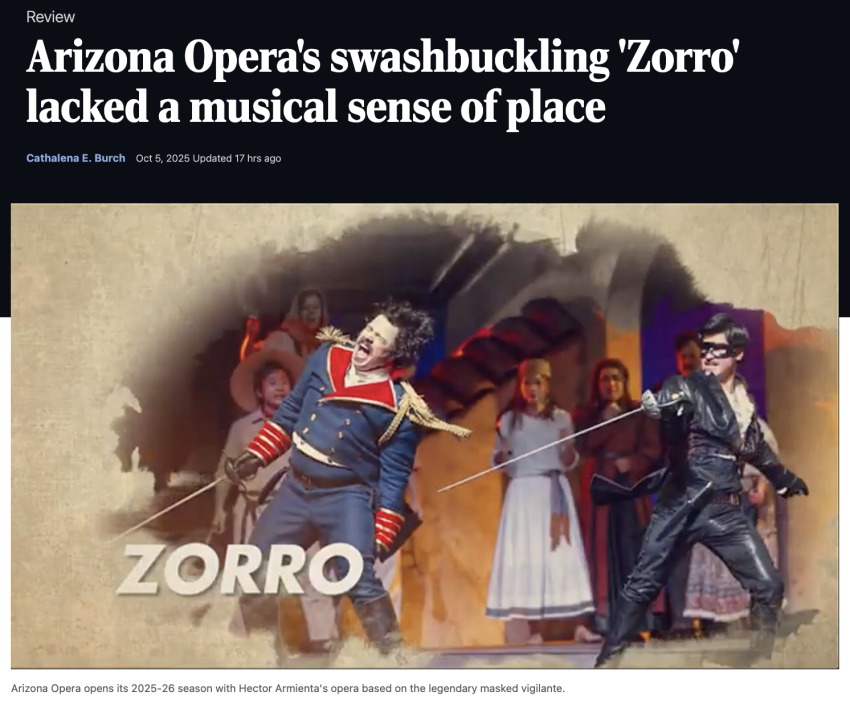

Arizona Opera checked the box on a couple of company milestones with its season-opening premiere of Héctor Armienta‘s “Zorro.”
It was the company’s first bilingual opera and the biggest selling new fall production for the company in more than a decade. And at Linda Ronstadt Music Hall on Saturday for the show’s one and only Tucson performance, it might have been the first time an audience booed one of the stars.
When the cast was taking its bows after the 2½-hour performance, the crowd nearly filling Linda Ronstadt Music hall booed when it was Tucson baritone Octavio Moreno’s turn.
Not that the audience didn’t love Moreno’s performance in the role of Moncada, the mayor of Pueblo Los Angeles. Moreno’s Moncada was the perfect villain and no one likes a villain, especially in a story where the bad guy has gone to such great lengths to suppress the little people under his rule.
Armienta’s “Zorro” is a reimagination of the iconic sword-swinging masked Spanish-Mexican vigilante who comes to the rescue of the peasants of Pueblo de Los Ángeles in Alta California, aka New Spain.
Zorro wields a sword to fight off the oppressors and earns the townspeople’s admiration and devotion while empowering them to stand up for their rights.
Armienta’s “Zorro” gave us deeper emotional connections to the masked avenger Diego de la Vega (Chilean-born tenor Xavier Prado) including his relationships with his childhood friend Carlota de Obregón (mezzo-soprano Stephanie Sánchez) and the love of his life Ana Maria Soza (Venezuelan soprano Maria Brea).
We also get a strong sense of his relationship to Moncada, once his best friend who is now his mortal enemy.
Armienta, who wrote the libretto and music, didn’t ignore the bumbling characters pulp fiction author Johnston McCulley included in his 1919 stories.
He created weak-kneed soldiers to carry out Mayor Moncada’s cruelty and gave his second in command Sgt. Gomez (the very funny and wonderfully voiced baritone Armando Contreras) deep-seated insecurities that have him questioning why the vivacious Luisa (the lovely voiced soprano Francesca Herrera) suddenly taken a romantic interest in him.
Arizona Opera’s production was a collaboration with Kentucky Opera and Opera San Jose, which mounted the production last April. Pardo, with a soaring tenor that never lost its sheen, and Brea, who had us holding our breath when she hit a few of those impossibly high notes, were in the San Jose show.
Sánchez brought a powerful mezzo to the role of Carlota, the heart-hurt spurned lover who goes to her grave to ensure Diego finds true happiness.
Then there was Moreno, whose rich and dramatic baritone created just the spark of evil to pull off the show’s most despised character. It was Moncada who sent Carlota to her grave, then tried to blame it on Ana Maria.
Armienta’s score was filled with beautiful melodies and lush music, but there weren’t enough overt Spanish or Mexican accents to match the characters or storyline. We wanted to hear distinct mariachi and fiery, electric flamenco rhythms. There were hints and flashes but we never felt that sense of place that music should have created.
Arizona Opera’s 2025-26 season continues with “Madama Butterfly” in February as part of the 2026 Tucson Desert Song Festival.