


Madama Butterfly
Review: Reimagined 'Butterfly' delivers much-needed cultural reckoning
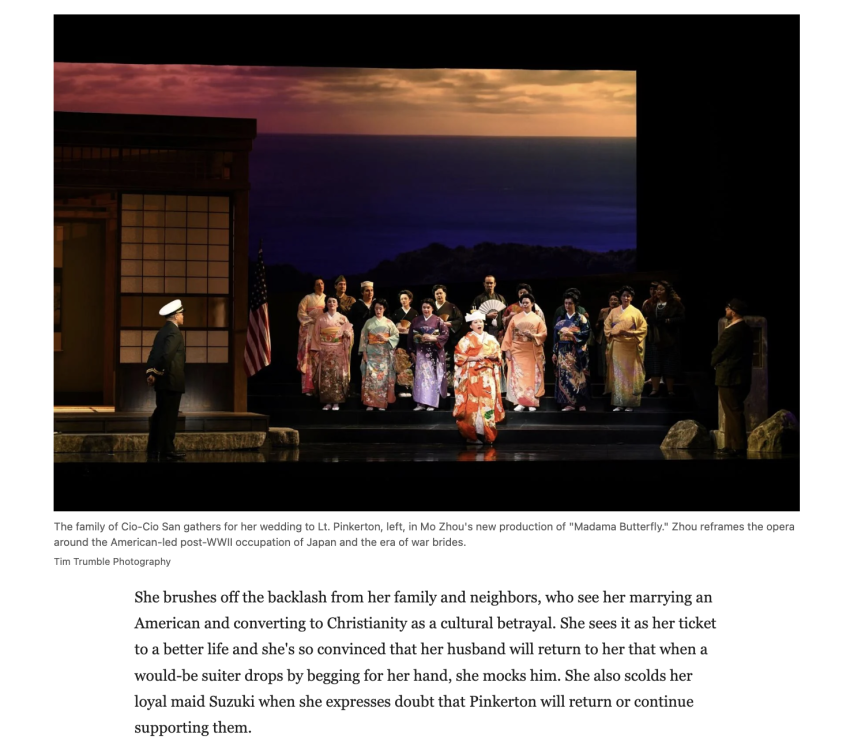

PHOENIX — After 120-plus years, Puccini's "Madama Butterfly" is due for a cultural reckoning.
Chinese-American director Mo Zhou delivers it in her new production, which Arizona Opera opened to a near full house at Phoenix Symphony Hall last Friday. It comes to Tucson's Linda Ronstadt Music Hall, 260 S. Church Ave., for a 2 p.m. show Saturday, Feb. 7.
Zhou hip-checks the racial and cultural stereotypes inherent in Puccini's story and adds needed historical context by setting the story in 1946 post-World War II Nagasaki.
It's a year after the Americans dropped the atomic bomb and spearheaded Japan's Allied occupation.
The story is still the same: Lt. Pinkerton secures a house and a teenage war bride, Cio-Cio San (Butterfly), from Goro, an unscrupulous broker, then leaves her with a promise to return, only to abandon her and the son she has after he's gone. When he returns six years later with his "American wife" to take his son to America, Butterfly tragically takes her own life.
But Zhou reframes the narrative, mining the emotional depth of Butterfly's character and giving her more control over her destiny.
Zhou's Butterfly is not a victim so much as a hero, someone who decides her own fate. She takes her life because "he who lives with honor must die with honor." Her life without Pinkerton or her son would be spent in the unforgiving shadow of pity.
Zhou also reimagines the young Butterfly as a determined woman who goes all in on the American dream, from her appearance — she wears her hair in a bob and dons a poodle skirt and sweater — to her allegiance — she hangs an American flag on her porch and a picture of the Allied Commander General MacArthur on her wall.
She brushes off the backlash from her family and neighbors, who see her marrying an American and converting to Christianity as a cultural betrayal. She sees it as her ticket to a better life and she's so convinced that her husband will return to her that when a would-be suiter drops by begging for her hand, she mocks him. She also scolds her loyal maid Suzuki when she expresses doubt that Pinkerton will return or continue supporting them.
Tenor Terrence Chin-Loy, an Arizona Opera regular, brought a delicious smarminess to Pinkerton as he tried to reassure his young bride that their love was forever. His duet with Butterfly, sung by the marvelous soprano Karen Chia-ling Ho, was stunning.
But the night on Friday belonged to Ho, making her Arizona debut as part of the Tucson Desert Song Festival. Ho's "Un bel dì, vedremo" (One fine day we'll see) aria with Suzuki (mezzo-soprano Alice Chung, who showed off some pretty impressive singing and acting chops) prompted a rousing round of hand-stinging applause.
Tenor Sam Krausz brought an all-too-familiar sliminess to Goro, the marriage broker, while the fine baritone Alexander Birch Elliott's Sharpless proved to be the most empathetic of the male characters.
Conductor Kelly Kuo led the orchestra in a brilliant performance of Puccini's poignant, lush score.